ILA expands its US Army (USAMRIID) agreement to lock in its Marburg dose optimisation study - topline results due H2 2026
Our 2025 Biotech Pick of the Year Island Pharmaceuticals (ASX: ILA) just expanded its agreement with the US Army's top infectious disease research institute (USAMRIID).
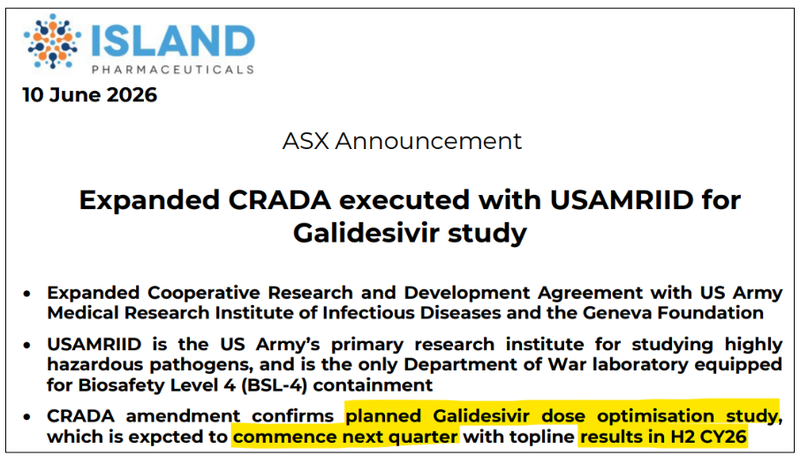
USAMRIID is the US Army's primary research institute for studying highly hazardous pathogens, and it is the only Department of War laboratory equipped for BSL-4 containment.
ILA’s expanded deal now confirms three things for ILA’s marburg disease trials:
- That study design for ILA’s dose optimisation is now complete.
- ILA has the resources it needs to get the dose optimisation study started, and
- ILA’s dose optimisation study will be run inside the US Army's only Biosafety Level 4 (BSL-4) containment facility.
ILA now has everything it needs to start the dose optimisation study (expected next quarter).
The study is expected to run for ~30 days with “topline results due H2-2026”.
(source)
ILA is holding a webinar to run through today’s announcement on Friday at 11am AEST:
ILA to start marburg virus studies next quarter
ILA is developing Galidesivir as a treatment for Marburg virus.
Marburg is a Category A bioterrorism threat (the highest level) with a fatality rate of up to 88%, and it is the only Category A biothreat with no vaccine and no approved treatment.
That gap is the whole point of the Investment - for Category A threats the US government stockpiles treatments to deploy in an emergency, so a drug that fills the Marburg gap has a clear potential government customer.
ILA's path to get there is unusually fast, because the FDA has agreed Galidesivir is eligible for the Animal Rule pathway.
This is an approval pathway based on animal data alone, skipping many years of human efficacy trials most drugs need, plus potentially a tradeable Priority Review Voucher which are worth ~US$200M.
Galidesivir already has:
- More than US$70M of mostly US-government-funded development behind it (spent by BioCryst with the US Department of War and BARDA),
- Completed human Phase 1 safety data, and
- Strong survival data in infected primates.
Next is the dose optimisation studies which is stage 1 of the two staged process to getting animal rule approvals for the drug.
The dose optimisation study is the first of two studies ILA needs to run under the Animal Rule.
Its job is to work out the minimally effective dose of Galidesivir against Marburg, and the best time to start dosing.
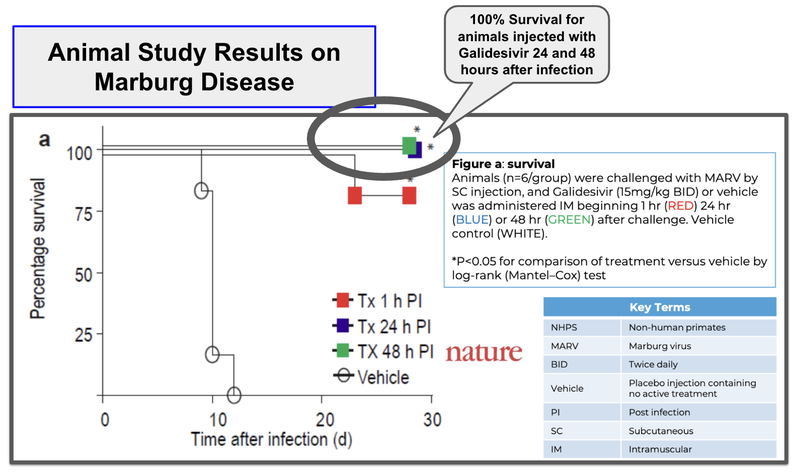
Under the study design, treatment begins 24 or 48 hours after the animals are exposed to Marburg, then continues via twice-daily intravenous dosing over a 14 day treatment period.
ILA's existing ~94% survival result was generated against the Marburg Musoke strain, whereas this optimisation study will be against the Marburg Angola strain, so the two studies are not strictly the same.
But we have a baseline to compare the next batch of results against:
(Source)
After the dose optimisation studies - it will be all about the pivotal trial - the final step before ILA can make an FDA submission for FDA approvals.
The pivotal trial is where ILA will take its “optimised dose” and see if it actually works as a Marburg treatment.
ILA’s drug also works against another major outbreak - Ebola
While Marburg is ILA's lead program, ILA’s galidesivir drug also has positive early trial results for Ebola, which has an outbreak currently unfolding in Central Africa.
The WHO declared the outbreak a Public Health Emergency of International Concern (PHEIC) on 17 May, and it has kept escalating since.
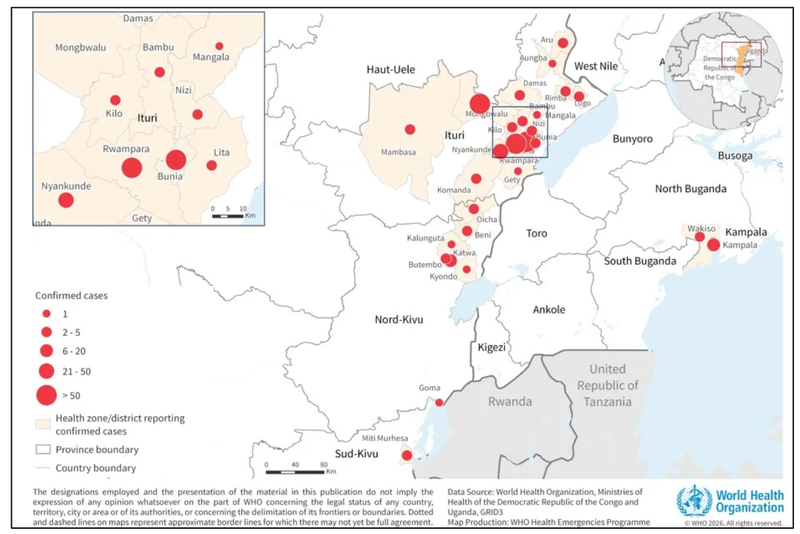
As of the WHO's 6 June update, the Democratic Republic of the Congo had reported 515 confirmed cases and 91 deaths, with Uganda reporting 19 confirmed cases and two deaths.
(source)
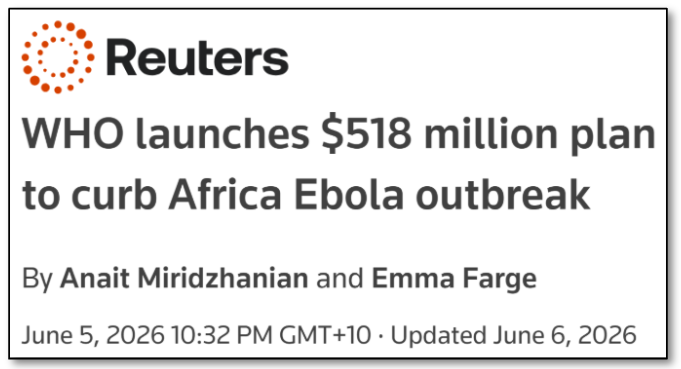
On 5 June, the WHO and the Africa CDC launched a joint US$518M plan to fight the outbreak through to November, with the DRC's health ministry warning of "rapid and continuous community transmission". (source)
(source)
The specific strain of this Ebola virus is what is of most interest to ILA and its Galidesivir drug.
This outbreak is caused by the Bundibugyo virus, a rarer strain of Ebola, and there is no approved vaccine or treatment for it - the WHO has noted that work is ongoing to test promising candidates.
Galidesivir is a broad-spectrum antiviral rather than a strain-specific vaccine, its strongest animal data is actually in Ebola (100% primate survival).
So because Marburg and Ebola are both filoviruses covered by the same patent family, the work ILA is doing for Marburg could translate directly across to Ebola.
A PHEIC also mobilises international funding and coordination - the same kind of declaration that triggered US government funding into Galidesivir back in 2016.
To be clear, Galidesivir is not an approved Ebola treatment, but it has US$70M spent on it prior, funded mostly by the US government (including the Department of War) for various diseases.
This includes works on Marburg and Ebola and has gone through phase 1 human safety trials (with no safety issues).
We went deeper on the outbreak and what it could mean for ILA in our most recent note:
What's next for ILA?
🔄 Marburg disease animal rule approval pathway
Next we want to see ILA execute the following:
- ✅ 17th November: ILA confirms Animal Rule eligibility for its Marburg drug
- ✅ 4th February: staged approach for FDA approvals confirmed
- 🔄 NEXT: We want to see ILA start “optimisation studies” ahead of a pivotal study later this year.
- 🔄 Ongoing: We want to see ILA sign more agreements with Biosecurity Level 4 (BSL4) facilities that are able to run animal studies - more sites means the studies can be completed quicker.
- 🔲 THEN, we want to see ILA start animal trials (pivotal trial) for Marburg disease. (this is the big one)
Assuming the clinical trial results are positive, ILA will then submit to the FDA for an Investigational New Drug Application (IND) of its drug (typically a 6-month review timeframe).
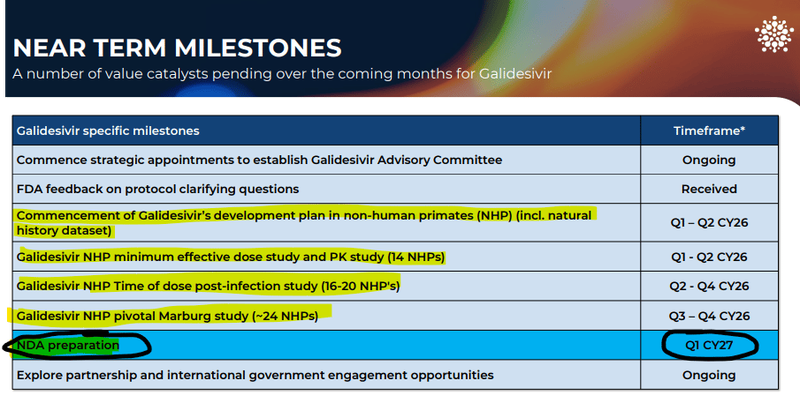
And all of this happens inside the next 12 months. ILA is targeting regulatory submissions in Q1-2027:

(source)
Here are the milestones we are tracking for the trials:
Stage 1 - Optimisation study:
- ✅FDA confirmed Animal Rule eligibility
- ✅FDA confirmed staged approach for approvals
- ✅CRADA (Cooperative Research and Development Agreement) signed with USAMRIID (US Army’s premier infectious disease research institute) and Geneva Foundation (highly influential non-profit that manages nearly US$383M in military medical research funding)
- 🔄Optimisation study (commencing soon)
Stage 2 - Pivotal study:
- 🔲 Pivotal study design completed
- 🔲 Pivotal study commences
- 🔲 Pivotal study results
- 🔲 FDA submission (NDA)
IF the pivotal study results are positive, ILA could then pursue:
🔲 FDA approval of Galidesivir for Marburg
🔲 Priority Review Voucher (~US$200M based on recent sales)
🔲 US Government Strategic National Stockpile contract (potentially worth hundreds of millions in revenue)
Here is an indicative timeline on when to expect all of the above from ILA’s recent presentation:
(source)